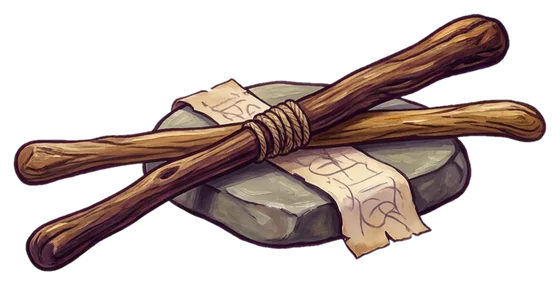
Each week, Come, Follow Me assigns a few chapters of scripture and suggests what to learn from them. The lesson for November 2–8 covers Ezekiel 1–3, 33–34, 36–37 and 47.[1] This essay makes three rebuttals. The two sticks are two kingdoms, not the Bible and the Book of Mormon. The God of these chapters orders children killed, which the lesson's "the Lord wants to forgive" leaves out. And Ezekiel 34 does not invite anyone to feed God's sheep: it fires the shepherds.
Background
Ezekiel was a priest. Babylon carried him off in 597 BCE (the same as BC), along with Jerusalem's king and "ten thousand captives" (2 Kings 24:14–15; Ezekiel 1:2–3). Babylon's own clay tablets list oil rations for that captive king, "king of the land of Yahudu," or Judah.[2] Ezekiel preached to the exiles in Babylon. The lesson's chapters 33–37 come after news arrived that Jerusalem had fallen (33:21).
Ezekiel teaches by acting things out, and then God tells him what each act means. That matters for the rebuttals below: the book explains its own signs.
Rebuttal 1: the two sticks are two kingdoms, not two books
Ezekiel says what the two sticks mean: two kingdoms will become one nation under one king. Nothing in the chapter is a book.
The lesson says the stick of Judah "can represent the Bible" and the stick of Joseph "can represent the Book of Mormon," and that "many scholars interpret" the sticks "as wooden writing boards."[1]
Ezekiel writes "For Judah" on one stick and "For Joseph" on the other, and holds them together as one. When people ask what it means, God gives him the answer: "I will make them one nation in the land upon the mountains of Israel; and one king shall be king to them all: and they shall be no more two nations" (Ezekiel 37:22). Judah and Joseph were the names of the two Israelite kingdoms, south and north, which had split centuries earlier (1 Kings 12:19–20). The Church's own Scripture Helps gives this meaning first, before adding that the sticks "can also represent written records."[3]
The "writing boards" idea comes from Keith Meservy, who argued in the Church's Ensign that the Hebrew word for "stick" matched a Babylonian word for a wax writing board.[4] Brian Keck checked the Babylonian, writing in Dialogue, a Latter-day Saint journal. The part of the word Meservy relied on was never spoken; it "existed solely in the written form of the language." Keck's conclusion: "the point of the whole passage is that just as Ezekiel brought two sticks together into one hand, so God will bring back the North and South Kingdoms."[5]
Rebuttal 2: the God who "wants to forgive" orders children killed
In these chapters God orders "little children, and women" killed without pity, and one sin cancels a lifetime of good. "The Lord wants to forgive" leaves that out.
The lesson's heading for chapter 33 is "The Lord wants to forgive," and it quotes God: "I have no pleasure in the death of the wicked" (Ezekiel 33:11). For how God left Jerusalem, it points readers to chapters 8–11.[1]
Here is what those chapters and the lesson's own chapters say:
- Chapter 9: God sends six armed men through Jerusalem: "Slay utterly old and young, both maids, and little children, and women ... neither have ye pity" (9:5–6). Only the men who mourned the city's sins are marked to be spared (9:4).
- Chapter 33: a good person who sins once loses everything: "all his righteousnesses shall not be remembered ... he shall die for it" (33:13). The people said "The way of the Lord is not equal" (33:17). The lesson asks what to say to someone who feels this is unfair. Eight verses after the lesson's passage ends, God promises the survivors in the ruins the sword, wild animals and plague (33:27).
- Chapter 36: Israel's sin is "as the uncleanness of a removed woman," that is, a woman on her period (36:17). The new heart the lesson praises comes with an order to "lothe yourselves," and "Not for your sakes do I this" (36:31–32).
- Chapters 16 and 23, which the lesson skips, picture Jerusalem as a wife God hands over to be stripped and stoned (16:37–40). The scholar Rachel Adelman counts Ezekiel among the prophets whose images "blame the daughter."[6]
A member may answer that chapter 9 is a vision. It is. But it is God's own picture of what "neither have ye pity" means, and no one today calls killing children for their parents' sins justice.
Rebuttal 3: Ezekiel 34 fires the shepherds
Ezekiel 34 does not invite anyone to feed God's sheep. God fires the shepherds and feeds the flock himself.
The lesson's heading is "The Lord invites me to feed His sheep." It asks, "Who are the 'sheep' the Lord wants you to feed?" and applies the chapter to missions, raising children and ministering.[1]
The shepherds in Ezekiel 34 are Israel's rulers, and the chapter is a charge sheet against them. They "feed themselves," and "with force and with cruelty have ye ruled them" (34:2–4). God's verdict: "Behold, I am against the shepherds; and I will require my flock at their hand, and cause them to cease from feeding the flock" (34:10). Then: "I will feed my flock" (34:15). The chapter takes the job away from the people who held it. If it speaks to anyone today, it speaks to those in charge, not to a member with a ministering assignment.
Closing
Two things in the lesson are right. Chapter 33 does say God would rather the wicked "turn from his way and live" (33:11), and chapter 34's attack on cruel leaders is fierce and fair.
The lesson keeps Ezekiel's comfort and leaves out the rest: the sticks are two kingdoms, the God of chapter 9 kills children without pity, and chapter 34 fires the shepherds instead of hiring them.
Notes
Scripture quotations are from the King James Version, the text used in the lesson. Ezekiel, KJV.
- "November 2–8. 'A New Spirit Will I Put within You': Ezekiel 1–3; 33–34; 36–37; 47", Come, Follow Me—For Home and Church: Old Testament 2026. The lesson cites Ezekiel 33:10–19, 34:11–31, 36:26–27 and 37:15–28 as wholes, and points to chapters 8–11 without quoting 9:5–7. It never quotes 37:22, where the sticks are explained, and does not cite 33:27, 34:1–10, 36:17, 36:31–32 or chapters 16 and 23.↩1↩2↩3↩4
- "Jehoiachin's Rations Tablets", Wikipedia, on the tablets in the Pergamon Museum, Berlin, citing the Center for Online Judaic Studies' translation ("Ya'u-kīnu, king of the land of Yahudu").↩
- "Ezekiel 1–3; 33–34; 36–37", Scripture Helps: Old Testament, on "What are the sticks of Judah and Joseph?"↩
- Keith H. Meservy, "Ezekiel's Sticks and the Gathering of Israel", Ensign, February 1987.↩
- Brian E. Keck, "Ezekiel 37, Sticks, and Babylonian Writing Boards: A Critical Reappraisal", Dialogue: A Journal of Mormon Thought 23, no. 1 (1990).↩
- Rachel Adelman, "Daughter Zion (Bat Tzion)", The Shalvi/Hyman Encyclopedia of Jewish Women, Jewish Women's Archive, 2021, on "the misogynist tropes in Hosea, Jeremiah, and Ezekiel that blame the daughter."↩