Each week, Come, Follow Me assigns a few chapters of scripture and suggests what to learn from them. The lesson for October 26–November 1 covers Jeremiah 31–33, 36–39 and Lamentations 1 and 3. It draws five teachings from them, and the last of its headings is "The Lord can relieve the sorrow I experience because of sin."[1]
Read in their own setting, these chapters support the lesson's stories, and they describe a far harder God than the lesson's headings do. The lesson's God "wants to forgive" and will "turn their mourning into joy." The chapters' God has "slain" and "not pitied" (Lamentations 3:43). The lesson tells children that Jerusalem fell "because the Israelites had not repented," and leaves it there.
The setting: a city under siege
In 597 BCE (BCE is the same as BC), Nebuchadnezzar, the king of Babylon, took Jerusalem for the first time. He "appointed there a king of his own choice," as a Babylonian record puts it.[2] The Bible names him: Zedekiah (2 Kings 24:17). Zedekiah rebelled, and Babylon came back. The siege ran from his ninth year until "the city was broken up" in his eleventh (Jeremiah 39:1–2), in 586 BCE.
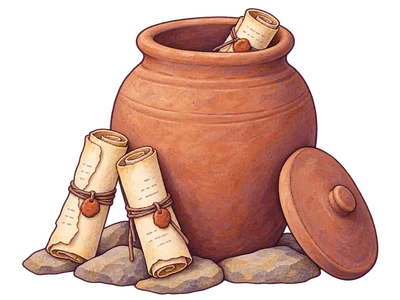
Chapter 36, the burned scroll, is earlier, about 605 BCE (25:1). Chapter 32 is from the siege: Jeremiah, in prison, buys a field and seals the deed in a clay jar, because "houses and fields and vineyards shall be possessed again in this land" (32:14–15). Lamentations is from after the fall, when "all her people sigh, they seek bread" (Lamentations 1:11).
The text: a book that says it grew
Jeremiah comes down to us in two versions. The old Greek translation, the Septuagint, is about one-eighth shorter than the Hebrew, and most scholars think the Hebrew behind the Greek is older.[3] The book itself says it grew: after the king burned the first scroll, a second was written, "and there were added besides unto them many like words" (Jeremiah 36:32). The Branch passage, 33:14–26, is missing from the Greek altogether.[4] Whoever wrote each part, these chapters were written by people watching their city starve and fall, and they say so.
Rebuttal 1: the God of these chapters slew, and did not pity
The lesson's heading for Lamentations is "The Lord can relieve the sorrow I experience because of sin," and its opening quotes Jeremiah: "I will turn their mourning into joy."[1] It asks children how they would have felt "if you were living there at that time," and explains that Jerusalem fell "because the Israelites had not repented."
The assigned chapter says what living there was like. "My priests and mine elders gave up the ghost in the city, while they sought their meat" (Lamentations 1:19): they starved to death looking for food. And in chapter 3, twenty verses after "great is thy faithfulness": "Thou hast covered with anger, and persecuted us: thou hast slain, thou hast not pitied" (3:43). The lesson's verse range, 3:20–33, stops ten verses short of that line.
The chapters the lesson skips are worse. "The children and the sucklings swoon in the streets of the city. They say to their mothers, Where is corn and wine?" (2:11–12). "The tongue of the sucking child cleaveth to the roof of his mouth for thirst" (4:4). "The hands of the pitiful women have sodden their own children: they were their meat" (4:10). Mothers boiled and ate their babies. The poet says who did it: "thou hast slain them in the day of thine anger; thou hast killed, and not pitied" (2:21).
A member may answer that the book itself calls the fall a punishment for sin (1:5, 1:8), and it does. But the lesson's chosen verses and its activity for children leave out what the book says God did to children. Timothy Sandoval, a religion professor at Texas Christian University, calls the idea that disaster proves sin "a profoundly dangerous ideology" that "can too easily be taken up to blame all sorts of victims."[6] In these chapters God starves a city, babies included, and the poet tells him to his face, "thou hast not pitied." The lesson keeps "great is thy faithfulness," skips the babies, and tells children the city fell "because the Israelites had not repented."
Rebuttal 2: children die for their parents' sins
The lesson asks readers to "ponder the difference it would have made if Zedekiah and his people had followed the prophet."[1] What happened to Zedekiah is in the assigned chapter: "the king of Babylon slew the sons of Zedekiah in Riblah before his eyes ... Moreover he put out Zedekiah's eyes" (Jeremiah 39:6–7). The lesson offers their deaths as what comes of not following the prophet.
The assigned chapters themselves say that is wrong. Jeremiah 31 promises a day when "every one shall die for his own iniquity." No one will say any more that "the fathers have eaten a sour grape, and the children's teeth are set on edge" (31:29–30). Ezekiel says it plainly: "The son shall not bear the iniquity of the father" (Ezekiel 18:20). The Church's second Article of Faith applies the same principle to Adam's sin: people "will be punished for their own sins."[7] Yet in these same chapters God says of King Jehoiakim, "I will punish him and his seed" (36:31). And Jerusalem's "children are gone into captivity" because "the LORD hath afflicted her for the multitude of her transgressions" (Lamentations 1:5). Today this is called collective punishment, and the Geneva Conventions forbid it: "No protected person may be punished for an offence he or she has not personally committed."[8] Jeremiah 31, Ezekiel 18 and the Church's own articles say no one should pay for a parent's sin. In the lesson's chapters children do, and the lesson holds up a king's executed sons as the cost of not following the prophet.
Rebuttal 3: Jerusalem is a woman stripped and shamed
Lamentations 1 pictures the city as a woman. The lesson's Scripture Helps notices one verse, "Jerusalem is as a menstruous woman" (1:17), and explains that the image "does not imply that menstruation itself is sinful or shameful."[5]
The chapter uses the woman for more than that. "Jerusalem hath grievously sinned ... all that honoured her despise her, because they have seen her nakedness" (1:8). "Her filthiness is in her skirts" (1:9). "The adversary hath spread out his hand upon all her pleasant things" (1:10). In plain words: her sin is pictured as sexual shame, and her punishment as being stripped and handled by an enemy. The Bible scholar Rachel Adelman traces the figure across the prophets, where "she has brought this devastation upon herself by playing the harlot," a prostitute. She notes that Lamentations also lets the woman "talk back" against "the misogynist tropes," the stock images, "in Hosea, Jeremiah, and Ezekiel that blame the daughter."[10] A member may say the picture is only a picture. It is one in which a woman's exposed body is the natural image of guilt, and her period the natural image of being unclean. Lamentations makes Jerusalem a woman whose stripped body and monthly bleeding stand for sin and shame. The lesson's guide defends one verse and says nothing about the rest.
Rebuttal 4: the promises were made to a city
The lesson reads Jeremiah's "new covenant" as the "new and everlasting covenant," which the Church's Guide to the Scriptures defines as the gospel restored "through the Prophet Joseph Smith," with "baptism and temple marriage."[11] It reads "the Branch of righteousness" as the Messiah.[1]
The covenant is made with "the house of Israel, and ... the house of Judah" (Jeremiah 31:31), the two kingdoms, and it is "new" compared with "the covenant that I made with their fathers" at the exodus (31:32). It sits among promises that the exiles will come home: a few verses later, "the city shall be built to the LORD from the tower of Hananeel unto the gate of the corner" (31:38). In chapter 33 the name "The LORD our righteousness" is given not to a king but to the city: "this is the name wherewith she shall be called" (33:16). The next verses promise a throne never without a king and priests never without a man "to offer burnt offerings ... continually" (33:17–18). Jeremiah's new covenant and his Branch are promises to two kingdoms that their city, their kings and their sacrificing priests will come back. The lesson keeps "written in their hearts" and skips the walls and the altar.
Closing
The lesson is right about the rest. King Jehoiakim cut up the scroll and burned it, and the answer was a second scroll (Jeremiah 36:23–32). Ebed-melech, a foreign eunuch, pulled Jeremiah out of the mud (38:7–13). And in places the lesson does not mention, the text is better than its age. Jeremiah condemns burning children to Molech (32:35). And 31:29–30 is one of the Bible's first clear statements that a child should not pay for a parent's sin.
These chapters describe a God who starved a city and killed its children, and a poet who told him he had not pitied. The lesson is right about the scroll, the brave servant and the grief. But it teaches a kinder God and a kinder book than the chapters it assigns, and it tells children only that the city had not repented.
Notes
Scripture quotations are from the King James Version, the text used in the lesson. Jeremiah, KJV; Lamentations, KJV.
- "October 26–November 1. 'I Will Turn Their Mourning into Joy': Jeremiah 31–33; 36–39; Lamentations 1; 3", Come, Follow Me—For Home and Church: Old Testament 2026. The lesson cites Jeremiah 31:31–34 and 32:37–42 for the covenant, 33:15 and 31:13 in its introduction, chapter 36, 37–39, and Lamentations 1:1–2, 1:16 and 3:20–33. It does not cite Lamentations 1:5, 1:8–10, 1:15, 1:19, 3:43, or chapters 2 and 4; nor Jeremiah 31:29–30, 31:35–40, 33:16–26 or 36:31.↩1↩2↩3↩4
- "ABC 5 (Jerusalem Chronicle)", Livius.org, reverse lines 11–13, on Nebuchadnezzar's seventh year (598/597 BCE).↩
- "Book of Jeremiah", Wikipedia, section on the Greek and Hebrew versions, citing Leslie Allen, Jeremiah: A Commentary (2008), and Marvin Sweeney.↩
- "Jeremiah 33:14 Commentaries", Bible Hub, the Cambridge Bible for Schools and Colleges ("it is lacking in the LXX") and the Pulpit Commentary.↩
- "Jeremiah 31–33; 36–38; Lamentations 1; 3", Scripture Helps: Old Testament, on "What is the book of Lamentations?" ("no author is mentioned by name") and "Why was Jerusalem compared to a 'menstruous woman'?"; compare the Guide to the Scriptures entry "Lamentations, Book of" ("written by Jeremiah").↩
- Timothy J. Sandoval, "Commentary on Lamentations 1:1-6", Working Preacher (Luther Seminary), October 2, 2022.↩
- Articles of Faith 1:2, The Church of Jesus Christ of Latter-day Saints: "We believe that men will be punished for their own sins, and not for Adam's transgression."↩
- Geneva Convention relative to the Protection of Civilian Persons in Time of War (Fourth Geneva Convention), 12 August 1949, Article 33, text at the Avalon Project, Yale Law School.↩
- Rachel Adelman, "Daughter Zion (Bat Tzion)", The Shalvi/Hyman Encyclopedia of Jewish Women, Jewish Women's Archive, 2021, citing Mandolfo, Daughter Zion Talks Back to the Prophets (Society of Biblical Literature, 2007).↩
- "New and Everlasting Covenant", Guide to the Scriptures, The Church of Jesus Christ of Latter-day Saints.↩